It doesn’t hurt.
You can chew fine.
You don’t see anything obvious in the mirror.
Maybe your dentist mentioned it at your last check-up — “just a small cavity.”
So you decide to wait.
That’s completely understandable.
But here’s what most people don’t realise:
Small cavities don’t stay small.
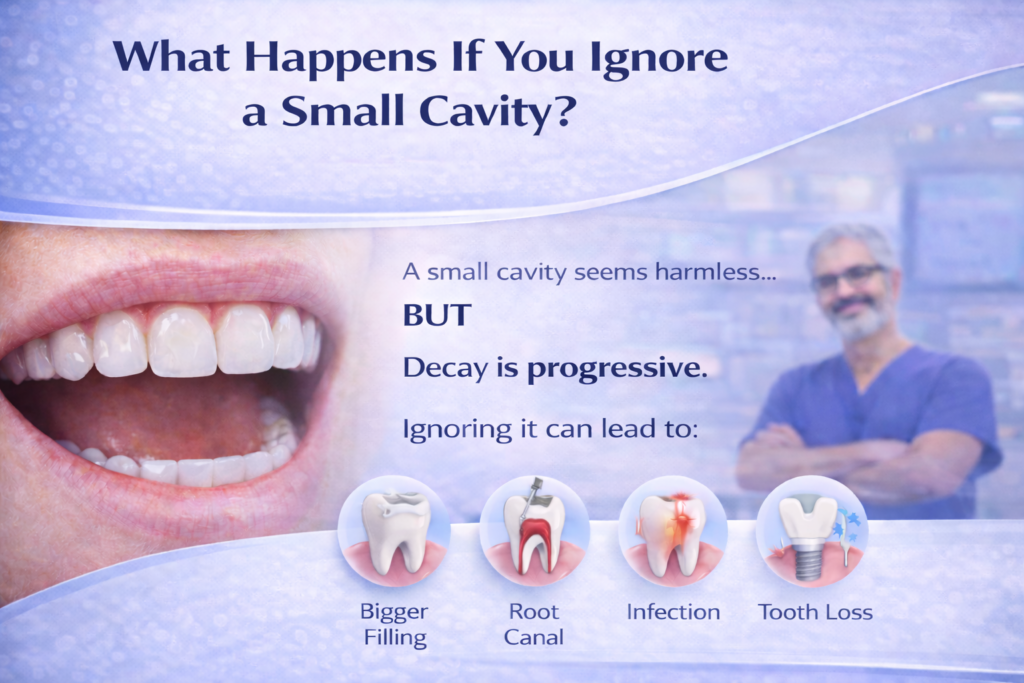
Tooth decay is progressive. Once it starts, it doesn’t reverse on its own. And the longer it’s left untreated, the more complex — and costly — the solution becomes.
Let’s walk through exactly what happens when a small cavity is ignored.
First: What Is a Small Cavity?
A cavity begins when bacteria in your mouth produce acids that slowly dissolve the outer layer of your tooth (the enamel).
In the early stages:
- You may not feel pain
- There may be no visible hole
- The damage may only be detectable on an X-ray
At this stage, treatment is usually simple: a small filling.
Quick appointment. Minimal discomfort. Predictable outcome.
But decay doesn’t pause. It continues to spread deeper into the tooth.
Stage 1: The Cavity Gets Bigger
Enamel is the strongest substance in your body. But once decay breaks through it, the softer layer underneath — dentine — is exposed.
Dentine decays faster than enamel.
This is where things begin to accelerate.
You might start noticing:
- Mild sensitivity to cold
- Discomfort with sweet foods
- Occasional twinges
The cavity is no longer “tiny.” It’s progressing.
Treatment at this stage usually means:
- A larger filling
- Removal of more tooth structure
- Higher risk of future problems
Still manageable. But it’s no longer minor.
Stage 2: The Nerve Becomes Involved
As decay continues, it moves closer to the pulp — the inner part of the tooth that contains nerves and blood supply.
Once bacteria reach this area, pain often becomes more noticeable.
Symptoms may include:
- Throbbing toothache
- Sensitivity to hot drinks
- Pain when biting
- Lingering discomfort
At this point, a simple filling is no longer enough.
You may now need:
- Root canal treatment
- A crown to protect the weakened tooth
What could have been a small filling has now become a more complex procedure.
Stage 3: Infection and Abscess
If the decay continues untreated, bacteria can infect the pulp entirely.
When this happens, pressure builds inside the tooth and surrounding bone.
This can lead to:
- Severe pain
- Facial swelling
- Gum swelling
- Bad taste in the mouth
- Difficulty chewing
In some cases, an abscess forms.
At this stage, treatment becomes urgent. The options may include:
- Root canal treatment
- Tooth extraction
- Antibiotics (if infection spreads)
Ignoring the cavity doesn’t make it go away. It increases the risk of significant complications.
Why Small Cavities Rarely “Settle Down”
Some people assume that if the tooth stops hurting, the problem has resolved.
Unfortunately, the opposite can be true.
If a tooth suddenly stops hurting, it may mean:
- The nerve has died
- Infection is spreading silently
No pain does not always mean no problem.
Decay is a bacterial process. It continues unless treated.
The Financial Reality of Waiting
Let’s talk practically.
A small filling is one of the most straightforward treatments in dentistry.
But once decay progresses, the costs increase because treatment becomes more involved.
For example:
Small cavity → Filling
Larger cavity → Bigger filling or onlay
Deep decay → Root canal + crown
Severe damage → Extraction + implant or bridge
Early intervention protects both your tooth and your budget.
Delaying treatment almost always increases the long-term cost.
What About “Watching It”?
There are situations where early enamel changes can be monitored.
But once a cavity forms in dentine, it cannot reverse naturally.
Your dentist will usually recommend treatment based on:
- Depth of decay
- Risk factors
- Oral hygiene
- X-ray findings
If treatment has been advised, it’s because progression is likely.
Why Early Treatment Is Always Easier
Small cavities require:
- Less drilling
- Less removal of healthy tooth
- Shorter appointments
- Minimal recovery
The tooth remains structurally stronger when treated early.
The more decay spreads, the weaker the tooth becomes.
And weaker teeth are more prone to cracking — which adds another layer of complexity.
The Psychological Factor
There’s also something else worth considering.
Dental problems rarely improve with time. But anxiety often grows.
A small issue left untreated can become:
- A source of stress
- A bigger procedure than expected
- An emergency situation
Dealing with it early provides peace of mind.
When Should You Act?
If you’ve been told you have a small cavity, it’s sensible to schedule treatment sooner rather than later.
You should especially act if you notice:
- Sensitivity increasing
- Pain when chewing
- Food getting trapped
- Visible dark spots on the tooth
Even if you feel nothing, recommended treatment is usually preventative — not reactive.
The Bottom Line
Ignoring a small cavity might feel harmless.
But decay is progressive. It doesn’t repair itself. It doesn’t stabilise on its own.
What starts as a simple filling can turn into:
- Root canal treatment
- A dental crown
- Tooth loss
Early treatment protects your tooth, reduces costs, and prevents avoidable pain.
If you’ve been told you have a small cavity, think of it this way:
You’re not fixing a problem.
You’re preventing a bigger one.